Practice. Train. Test. Compete.

Understanding the difference might change how you approach your next workout.

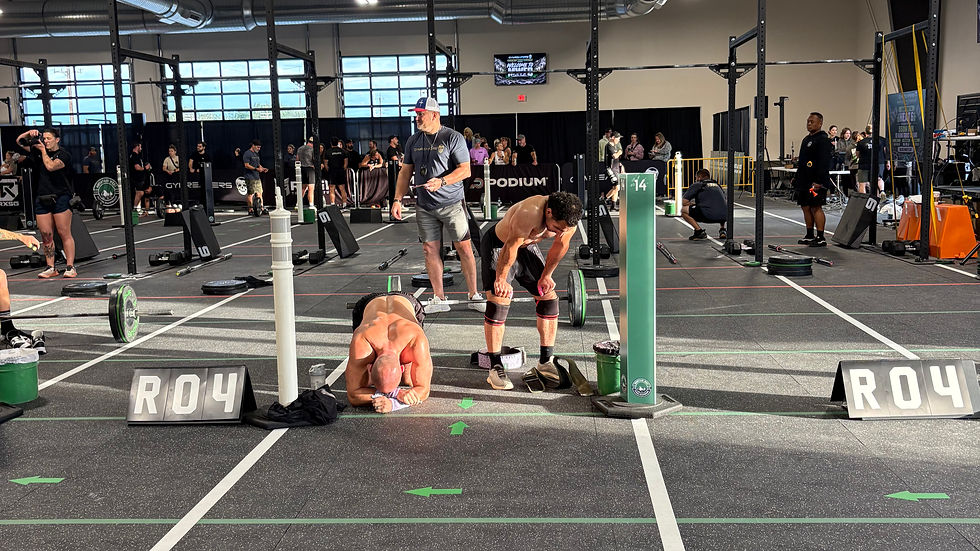
I recently got back from the Mountain West Championship in Caldwell, Idaho, where my partner and I competed in seven events over two days.
Some were brutally hard. Others were more manageable. A few exposed things I could improve, while others reminded me why I spend so much time training the way I do.
And during one event, I absolutely ate shit going over a four-foot barrier.
We'll get to that.
Looking back, what interested me most wasn't necessarily how we placed. It was how much of our performance came down to things we'd spent time developing before we ever arrived. Not just fitness, but skills, strength, pacing, and knowing when to push versus when to hold something back.
It reminded me of something I've been thinking about for a while.
There's a difference between practicing, training, testing, and competing.
They overlap, and each has value, but they're not interchangeable. Understanding the difference can change how you approach your workouts, whether you're preparing for a competition or simply trying to get a little better at this whole fitness thing.
Practice: Getting better at the skill
One of the events at Mountain West included five sets of 30 double-unders, along with a bunch of other movements.
Pretty standard CrossFit stuff, right?
Except we weren't using speed ropes. We were using those old-school plastic beaded ropes you probably remember from elementary school playgrounds. They're heavier, harder to turn over, and require a slightly different rhythm.
I ended up doing most of our double-unders and didn't trip once.
Not because I'm some jump-rope wizard. I've just spent a considerable amount of time practicing with different ropes.
I own an RXSG EVO speed rope, a standard RX jump rope, a drag rope, a heavier class-style rope, and even an adaptive single-handle rope. I've practiced singles, doubles, and triples with most of them.
Do I need five different jump ropes? Probably not. But apparently I've decided that's who I am as a person.
The point is that when I was handed a different rope in competition, the movement wasn't foreign to me. I'd already put in the work.
That's what practice is for.
Practice is where we develop skill. We improve mechanics, coordination, positions, and efficiency without making the outcome about how fast we're going or how much weight we're lifting.
It's where you learn to wrap your feet properly on a rope climb before trying to race someone up the rope. Where you learn to keep the bar close during a snatch before loading it with weight. Where you figure out how to turn a jump rope efficiently instead of just jumping higher and hoping for the best.
Practice doesn't have to be complicated, and it certainly doesn't require an entire hour dedicated to PVC pipes and technique drills. Sometimes it's ten minutes at the beginning of class. Sometimes it's working with an empty barbell or spending a few minutes developing a skill you haven't mastered yet.
For someone learning a movement, that might mean keeping the load below 50% or removing it entirely. For an experienced athlete, practice might happen at considerably heavier percentages. The point isn't the number on the bar. It's the intention.
You're trying to improve the movement, not prove you can survive it.
Another Mountain West event involved rope climbs and progressively heavier snatches. Having efficient footwork on the rope meant I wasn't unnecessarily exhausting my arms and grip before returning to the barbell.
And in an event with synchronized bar muscle-ups followed by unbroken handstand walking, the importance of skill was even more obvious.
You could have the aerobic capacity of a racehorse, but if you couldn't perform the required gymnastics, your engine wasn't going to save you. Especially when dropping out of the handstand walk meant starting that section over.
Ben Bergeron has discussed the distinction between practice, training, and competition extensively, including the importance of separating skill development from performance.
I agree with that philosophy. I just don't think every athlete needs to follow some universal percentage of time dedicated to each.
What matters is recognizing when you're supposed to be learning.
Because sometimes the thing preventing you from going faster isn't your engine. It's your skill.
Training: Building the capacity
If practice develops our skills, training develops the physical qualities that allow us to use them.
Strength, endurance, power, stamina, muscular endurance, and the ability to recover and repeat efforts.
This is where we should spend most of our time.
Training isn't necessarily easy. Sometimes it's brutally hard. Other times it's deliberately controlled. The difference is that the intensity should serve a purpose.
Intensity is a prescription, not a competition.
Think about an aerobic workout where the intention is to maintain a sustainable pace for 30 minutes.
If you turn the first five minutes into a race against the person next to you, blow up, and spend the remaining 25 minutes trying to recover, you probably missed the intended stimulus.
You might have worked really hard. That doesn't automatically mean you trained effectively.
On the other hand, if the goal is to develop the ability to sustain a high output near your threshold, you probably need to get uncomfortable. And if we're developing maximal strength, eventually we need to lift some heavy shit.
Different adaptations require different demands.
This is something endurance coach Chris Hinshaw has emphasized in his work with CrossFit athletes: understanding the purpose of an effort and developing the ability to control intensity are essential parts of improving performance.
At Mountain West, our first event was a pretty good example.
The workout alternated two-minute working windows between partners for eight total rounds, four each.
Every round started with a 100-foot sandbag bear-hug carry using a 150-pound sandbag, followed by six burpees over a four-foot barrier. Whatever time remained was spent accumulating calories on the rower.
The team target was 230 calories.
That's almost 29 calories per round, with roughly 60–75 seconds of rowing time after the carry and burpees.
Not exactly a casual paddle around the lake.
We finished with 209 calories, and I maintained approximately 27–32 calories across my four rounds.
That wasn't simply a matter of going as hard as humanly possible every time I sat down. It was knowing what kind of output I could produce, recover from, and repeat.
Had I emptied the tank during my first round, the following three could have looked very different.
Oh, and during round two, on my final burpee before getting to the rower, I absolutely ate shit over the barrier.
A beautiful display of athleticism. Very graceful. Ten out of ten.
Fortunately, I was still able to get on the rower and do my job.
That's another thing worth understanding about training: the goal isn't to eliminate fatigue. It's to develop the ability to perform under the demands of the task.
Sometimes those demands require a high heart rate. Sometimes they require precision under load. Sometimes they require restraint.
And sometimes they require recovering your dignity after falling over an obstacle in front of a bunch of people.

Your priorities determine your progress
Here's another example from the weekend.
My best overhead squat is 297.5 pounds. My best deadlift is 505 pounds.
My best snatch? 220 pounds.
Clearly, strength isn't my only limitation in the snatch. There are technical and other physical qualities I could spend more time developing to improve that lift.
And I probably should.
Would I love to snatch 300 pounds? I sure as shit would.
But do I want that badly enough to take time away from other things I care more about improving?
Not really.
And that's fine.
I can't decide that something isn't a major training priority and then act surprised when I don't perform particularly well at it.
The same applies to anyone training at PUSH.
If you want to get better at pull-ups but never spend time developing your pulling strength or technique, you can't reasonably expect them to improve just because you're showing up to class.
If you want to become a better runner but avoid running whenever possible, the results probably won't be shocking.
This doesn't mean everyone needs to prioritize everything. Actually, it's the opposite.
Understand what matters to you, then train accordingly.
Your goals determine what deserves your time and attention, and your results will generally reflect where that attention has gone.
Testing: Finding your ceiling
Training is where we work on raising our capacity.
Testing is where we find out what that capacity actually is.
Think of it this way: if training is the process of building a higher ceiling, testing is when we reach up and see how high that ceiling has become.
A one-rep-max back squat. A 2,000-meter row. A five-kilometer run. Max unbroken ring muscle-ups. A benchmark workout performed under consistent standards.
These are opportunities to measure performance. Not guess or assume, but actually measure.
James FitzGerald, the founder of OPEX and the first CrossFit Games champion, has long emphasized assessment as part of effective program design.
And that's something I strongly believe in.
If we never test anything, how do we know whether our training is producing the results we're after?
Sure, we can often feel improvements. Movements get easier. We recover faster. We notice we're using heavier weights.
But having actual data gives us something more objective.
That's a big reason we build testing and retesting into our training cycles at PUSH. It gives us a starting point, helps guide the training process, and provides an opportunity to see what changed.
Testing doesn't always mean finding your one-rep max, either.
Sometimes it's discovering how fast you can row 500 meters. Sometimes it's seeing how many strict pull-ups you can perform. Sometimes it's measuring your performance in a workout you've completed before.
The important distinction is the intention.
When we're testing, we're trying to find the limit of our current ability under the conditions of that test. That's different from training, where the goal is to create an adaptation.
Of course, a test can also provide a training stimulus. These aren't completely separate worlds. But the primary objective is different.
And because meaningful testing often requires significant effort and recovery, we shouldn't approach every workout as though we're trying to set a personal record.
Sometimes you need to find your ceiling. Most of the time, you need to work on raising it.

Competition: Using what you've built
Here's where I think things get especially interesting.
Competition isn't simply another word for testing.
In testing, we're trying to discover our maximum ability in a specific task. In competition, we're trying to produce the best possible result against the demands of an event and the people we're competing against.
Sometimes that means going absolutely all-out. Other times it means being strategic.
One Mountain West workout was four rounds of a 550-meter run and 10 hang squat cleans at 185 pounds for the men and 125 pounds for the women.
Partners ran together and divided the cleans.
Unfortunately, my partner was dealing with a back issue, which meant our original plan changed. I ended up taking approximately 75–80% of the cleans.
Suddenly, the way I approached the running mattered even more.
If I treated every 550-meter run like a maximum-effort test, I'd have been paying for it when I got back to the barbell. And with three more rounds ahead of us, that would have been a pretty stupid strategy.
The goal wasn't to run the fastest possible 550 meters. The goal was to complete the entire workout as quickly as we could.
Those are two very different objectives.
Our final event was another example.
It included 25 calories on the Echo bike, 15 synchronized bar-facing burpees, 20 synchronized thrusters at 95 pounds, another 15 synchronized burpees, and a final 25 calories on the bike.
Seven-minute cap.
By the time we reached the end, there was no reason to save anything for another event. That was the time to go.
I was able to finish the final 15 calories on the Echo bike in roughly 10 seconds.
And that ability to recognize when I could push, how hard I could push, and when there was no longer any reason to hold back came from training.
But competition also exposed the importance of practice.
I wasn't practicing double-unders when those beaded ropes showed up. I wasn't learning how to wrap my feet on a rope climb while trying to conserve energy for heavy snatches.
I was using skills I'd already developed.
Competition is where you express what you've built, not where you hope to magically develop what you've neglected.
And sometimes competition reveals exactly what you should go back and work on.
Which brings us right back to practice and training.
So what does this mean for your next class?
You don't need to be a competitive CrossFit athlete for any of this to matter.
You don't even need to care about the leaderboard.
If your goal is to stay healthy, build strength, move better, and enjoy training with good people, that's a perfectly good reason to show up.
But having that goal doesn't mean you should stop being intentional.
You can practice your squat mechanics because you want to move better. You can train your aerobic capacity because you want to feel better and recover faster. You can test your strength because you're curious whether the last eight weeks of training actually worked.
And if you enjoy competing, whether it's a local event or simply a friendly challenge with someone in class, you can use those opportunities to see how your preparation holds up.
The mistake isn't caring about performance. It's approaching every part of training as though performance is the only thing that matters.
Sometimes the smartest thing you can do is take weight off the bar. Sometimes it's slow down. Sometimes it's push harder.
And sometimes it's accepting that you're not particularly good at something because you haven't put much effort into getting better at it.
There's nothing wrong with that last one, by the way. We all have priorities.
Just don't confuse choosing not to prioritize something with being incapable of improving it.
After nearly two decades of coaching, one thing I continue to believe is that people get more out of training when they understand what they're trying to accomplish.
Not every day needs to be a personal record. Not every workout needs to leave you on the floor. And not every skill needs to be mastered to an elite level.
But every time you walk into the gym, you should have some understanding of what you're there to do.
Practice with purpose. Train for adaptation. Test to measure progress. Compete to perform.
And if you happen to eat shit over a four-foot barrier along the way?
Get up and finish your row.
Work Hard. Be Kind. Stay Dope.


Comments